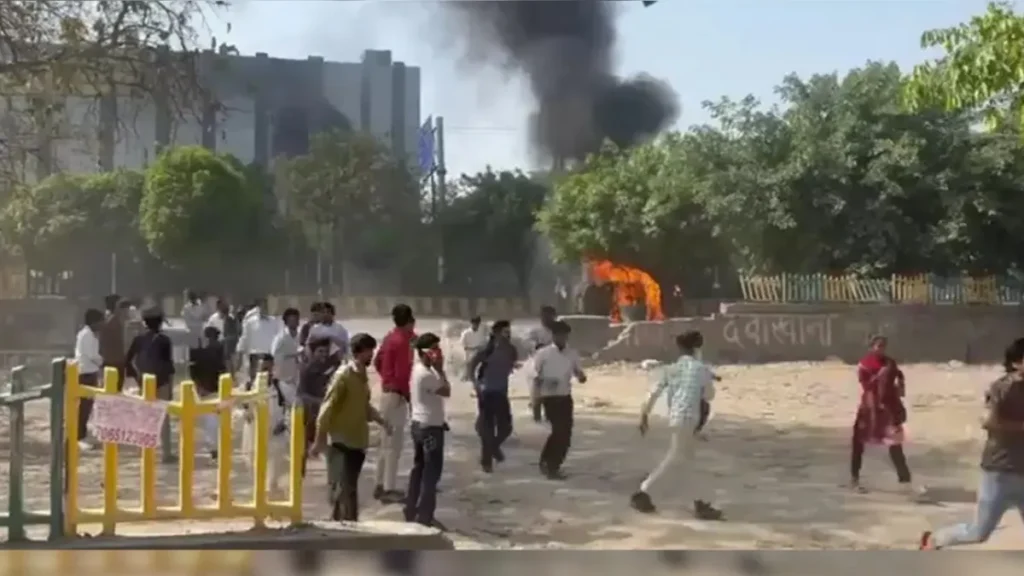
A major noida protest by factory workers turned tense on Monday morning after demonstrators clashed with police, vandalised vehicles, and blocked key roads in the industrial hub. The unrest erupted in the Phase 2 industrial area of Noida, where hundreds of workers from various factories gathered to demand higher wages, better working conditions, and improved labour rights.
Authorities rushed additional police forces to the area after the protest escalated into violence, causing widespread traffic disruption and concern among local residents and businesses. Officials say they are closely monitoring the situation while urging workers to maintain peace and avoid rumours.
Violence Breaks Out During Worker Demonstrations
According to eyewitness accounts and videos circulating online, some protesters damaged vehicles, including a police van, and threw stones during the confrontation. The noida protest intensified as police attempted to disperse the crowd and restore order in the industrial sector.
The clashes took place in the heavily industrialised Phase 2 area, home to several manufacturing units employing thousands of workers. Protesters blocked major roads, leading to significant traffic congestion during the Monday morning rush hour.
Police officials confirmed that senior officers were deployed at the protest site to manage the situation. Authorities stated that they are engaging in dialogue with workers to calm tensions and ensure that the situation does not spiral further.
Wage Disparity Sparks the Noida Protest
The latest noida protest was triggered by a recent announcement from the Haryana government regarding a substantial increase in minimum wages. Haryana approved a 35 percent hike in minimum wages for unskilled workers, raising the monthly pay from ₹11,274 to ₹15,220.
The wage revision also increased the salaries of semi-skilled workers from ₹12,430.18 to ₹16,780.74 per month. Additionally, skilled and highly skilled workers in Haryana received similar wage increases of about 35 percent.
Factory workers in Noida argue that they are performing the same jobs as workers in neighbouring Haryana but are paid significantly less. This disparity has fueled anger among labourers who believe they deserve equal pay for similar work.
Many workers participating in the noida protest are demanding that the Uttar Pradesh government revise the state’s minimum wage structure to match Haryana’s updated rates.
Workers Raise Concerns About Exploitation
Apart from wage issues, workers also voiced serious concerns about working conditions in several factories. Protesters claim they face long working hours, insufficient safety measures, and inadequate facilities at workplaces.
Lakshmi, one of the workers participating in the noida protest, said employees are simply asking for fair treatment and better wages.
“We are asking for just two things — overtime pay and a minimum salary of ₹20,000 per month,” she said. “We are being exploited in our company. Sometimes meals are not provided on time, and women workers do not feel safe.”
Her statement reflects the frustration among workers who believe their basic rights are being ignored despite contributing to industrial productivity.
Another worker, Akshay, pointed out the growing gap between wages in Noida and nearby industrial centres.
“In Gurugram, workers are getting around ₹20,000 per month, but here we are paid only ₹10,000,” he said. “Sometimes even ₹1,000 gets deducted from our salaries.”
Protesters Demand Pay Parity
Many demonstrators say the noida protest is not just about wages but about fairness and dignity in employment.
Ankur Kumar, another worker at the protest, questioned the value of working in major industrial cities if wages remain so low.
“What is the point of working in big cities if there is no pay parity?” he asked. “We are being exploited by the system. When we raise our voices, we are met with violence. We want the government to intervene and protect workers.”
Workers are also highlighting issues such as the lack of weekly holidays, unsafe factory environments, and the absence of effective grievance redressal mechanisms.
Government Responds to the Noida Protest
Uttar Pradesh Chief Minister Yogi Adityanath acknowledged the concerns raised by workers during the noida protest and stated that labour rights must be respected.
He said that workers deserve a respectable salary, safe working conditions, and access to essential facilities.
At the same time, the Chief Minister warned that authorities would take strict action against individuals attempting to incite violence or create unrest under the guise of labour protests.
He also directed officials to strengthen security in industrial areas and prevent any anti-social elements from exploiting the situation.
The state labour department has been instructed to hold discussions with factory managements and local authorities to address the grievances raised by workers.
Officials Urge Workers to Remain Calm
District Magistrate Medha Roopam appealed to workers to maintain peace and avoid being influenced by rumours.
In a public statement, she urged workers to return to their workplaces and cooperate with authorities to maintain law and order in the district.
She also shared several control room numbers for workers seeking assistance or clarification regarding labour-related issues.
Officials emphasised that dialogue remains the best way to resolve the concerns raised during the noida protest.
Also Read: Asha Bhosle Death: Legendary Indian Playback Singer Passes Away at 92 After Chest Infection
Situation Under Close Watch
Police officials confirmed that they are using minimal force while trying to control the situation and restore normalcy. Security has been increased across industrial zones in Noida to prevent further unrest.
Authorities are continuing discussions with worker representatives and factory managements in an attempt to find a peaceful resolution.
As tensions remain high, the noida protest has once again brought attention to the broader issue of wage disparities and working conditions in India’s industrial sectors. Workers hope their voices will lead to meaningful policy changes, while the government faces pressure to balance industrial growth with fair labour practices.